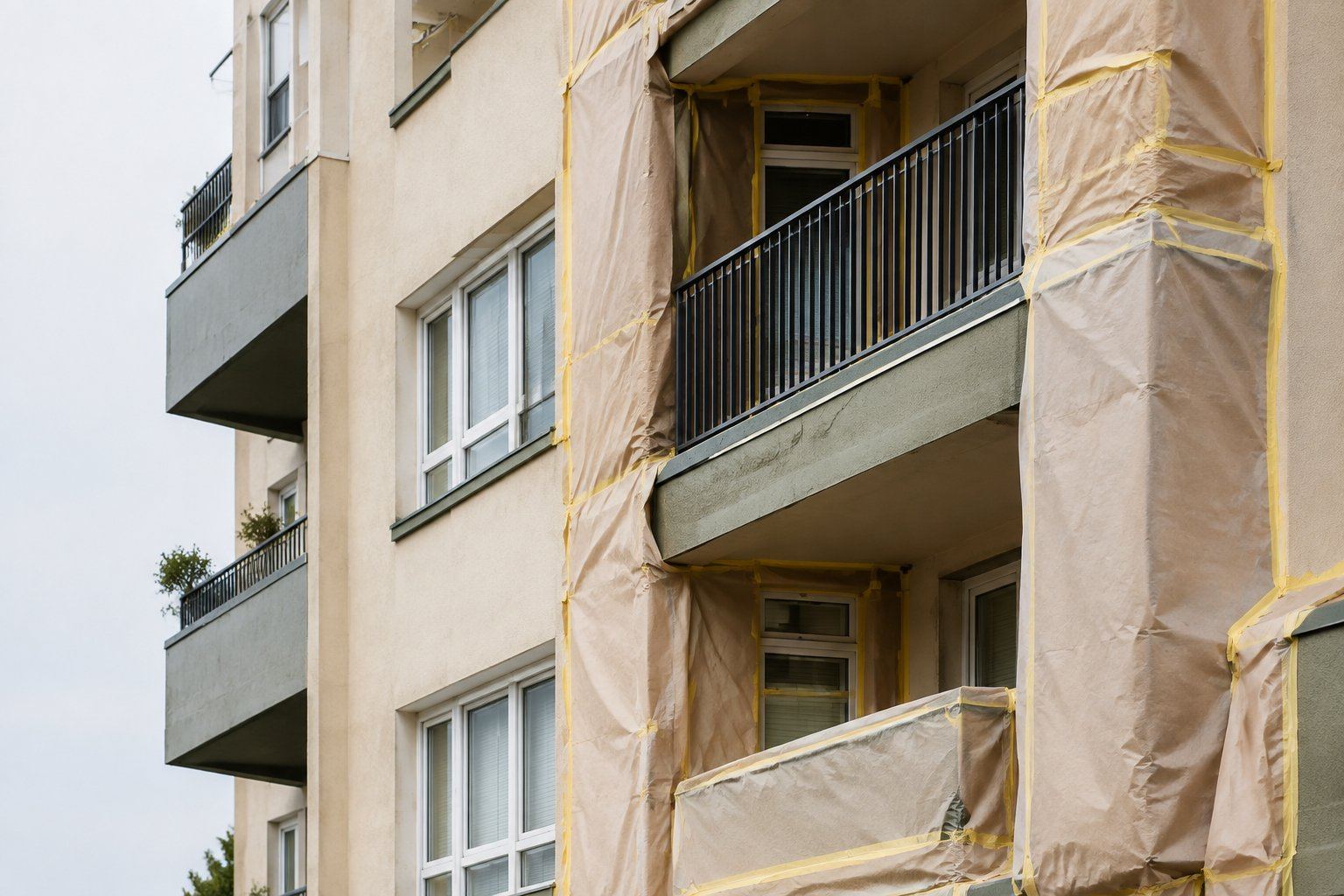
Who is responsible for painting in a strata scheme?
In Tasmania, the body corporate is responsible for common property. The Strata Titles Act 1998 requires it to control, manage and improve the common property and to maintain it in good condition and serviceable repair. The Land Titles Office gives painting buildings on common property as an example.
Common property can include external walls, stairwells, lobbies and shared fences, but the exact boundary between common property and individual lots is set by your strata plan and by-laws. Painting inside a lot is normally the owner's own job and cost. Check the strata plan before you define the scope, especially for balconies, doors and window frames.
Paying for a repaint
A major repaint should not come as a surprise. The Strata Titles Act requires the body corporate to keep a fund at a level sufficient to meet reasonably foreseeable expenditure. A national exterior painting guide suggests repainting every 5 to 10 years, so it is exactly the kind of cost a fund should plan for.
Three sections of the Act are worth knowing:
- Section 81 sets out the body corporate's functions, including maintaining the common property in good condition and serviceable repair.
- Section 82 requires a fund to meet the body corporate's financial obligations, which may be split into recurrent and capital parts.
- Section 83 lets the body corporate levy contributions to meet anticipated expenditure, in proportion to unit entitlements in a strata scheme.
If the fund is not large enough when the building needs painting, the committee can levy contributions, stage the work over more than one year or both. Owners appreciate early warning, so put the repaint on the agenda well before it is due.
What strata painting costs in Hobart
As of September 2026, a published Hobart commercial painting cost guide puts a strata common-area repaint at $11,750 to $46,950 for a whole project, and commercial painting generally at $12 to $35 per square metre, GST included. Access, preparation and building height set where a scheme lands.
The same guide lists:
| Item | Hobart range |
|---|---|
Strata common-area repaint, whole project | $11,750 to $46,950 |
Interior repaint, walls and ceilings | $7.83 to $23 per m² |
Exterior repaint, facade and render | $20 to $47 per m² |
Surface preparation | $6.26 to $20 per m² |
High-access loading (platform or scaffold) | $390 to $1,575 per day |
After-hours loading | $275 to $705 per day |
Site inspection and specification | $155 to $390 per job |
The same guide notes that strata schemes and ongoing repaint cycles usually attract keener per-square-metre rates than one-off jobs, and describes strata work as staged around residents and signed off by the owners committee.
Step by step: planning a strata repaint
A well-run strata repaint follows a clear sequence: assess, specify, quote, decide, notify and supervise. Without a written specification, quotes are hard to compare and owners cannot see what they are paying for. Allow several months from the first inspection to the start date.
- Assess the condition. Walk the building and note peeling paint, rust, rot, cracked render and water damage. Photograph problem areas.
- Confirm the scope. Use the strata plan and by-laws to confirm what is common property. List every surface to be painted.
- Write a specification. Describe preparation, products, number of coats, colours and access limits. A site inspection by a painter or consultant can help.
- Get comparable quotes. Give every painter the same specification and ask for preparation, access equipment and any after-hours work as separate lines.
- Decide under your by-laws. Follow your scheme's by-laws and the Act for how the decision is made and recorded, and keep the quotes with the minutes.
- Tell owners and residents. Give notice of dates, access needs, balcony clearing, parking changes and window-opening limits.
- Supervise and sign off. Agree how progress is checked and who approves the finished work.
Older buildings: asbestos, lead and heritage
Older strata buildings bring extra checks. Buildings built or renovated before 1990 can contain asbestos, and paint on buildings from before 1970 is more likely to contain lead. Heritage listing can also affect colours. Check all three before specifying the job.
Asbestos. The Asbestos Safety and Eradication Agency says homes built before 1990 can contain asbestos inside and outside and that high pressure water and compressed air must not be used on asbestos materials. It adds that tradespeople, including painters, must comply with work health and safety laws. If the body corporate holds an asbestos register or survey, give it to every painter who quotes.
Lead. The Lead Alert guide says homes built before 1970 are most at risk of lead paint, and that lead paint should not be removed by dry sanding or dry abrasive blasting.
Heritage. Some older apartment and terrace buildings are heritage listed. Repainting a council-listed place in a similar colour is exempt from a planning permit, but places on the Tasmanian Heritage Register need Heritage Council approval, and a new colour scheme may need a permit. See our heritage guide.
Choosing colours as a committee
Colour is where strata repaints get contentious. A new scheme changes how every owner's home looks, so the decision deserves a proper process. Narrow the options to two or three schemes, paint large test patches on the building and give owners time to see them in different light.
Check your by-laws for how decisions about the appearance of common property are made, and whether a particular type of resolution is required. If the building is heritage listed, check approvals before owners vote on a scheme that may not be permitted.
Living in the building during the work
Residents stay home while their building is painted, so the program matters as much as the price. Ask the painter how they will stage the work, keep exits and stairwells safe, protect cars and balconies and manage noise, fumes and wet paint in shared areas.
The Hobart commercial guide lists after-hours loadings of $275 to $705 per day as of September 2026. For stairwells and lobbies, staged daytime work with clear signage avoids that loading, while after-hours work can suit entrances that cannot close.
Get a quote
Request a quote and choose "commercial or strata" as the service. We will pass your request to a local Hobart painter, who will contact you within one business day. painters-hobart.com.au is an independent referral service, not a painter. See also our commercial and strata painting page.
Sources
- Tasmanian Government, Strata Titles Act 1998, sections 81, 82 and 83 (accessed 1 October 2026)
- Department of Natural Resources and Environment Tasmania, Land Titles Office, Body Corporate: Strata Schemes (accessed 1 October 2026)
- Published Hobart commercial painting cost guide, updated September 2026 (accessed 1 October 2026)
- National exterior painting cost guide, updated 6 January 2026 (accessed 1 October 2026)
- Asbestos Safety and Eradication Agency, Asbestos in the home (accessed 1 October 2026)
- Australian Government, Lead Alert: The six step guide to painting your home, 5th edition, 2016
- Tasmanian Heritage Council, Works Guidelines for historic heritage places, Version 2, October 2025